NEWYou can now listen to Fox News articles!
The world feels more dangerous than it's been in a generation. As the United States finds itself back in active conflict in the Middle East, Russia's full-scale war against Ukraine grinds into its fifth year. The world holds its breath to see whether China moves on Taiwan. And after decades of treating our defense industrial base like a peacetime operation, that strain is exposing just how fragile America's arsenal can become.
For decades, the Pentagon has bought munitions the way a peacetime military does: year to year, program by program, with procurement requests that shift with each budget cycle. Years of perceived peace let us coast on the stockpiles already built, without reckoning with the impact this had on our industrial base. Manufacturers were left guessing at demand from one year to the next, and that uncertainty withered production capacity over time.
The war in Iran put this problem on full display. The conflict has put sustained demand on precision munitions and air defense interceptors – affecting both the United States and our allies. Gulf partner nations have warned U.S. officials that their interceptor stocks are running dangerously low, and the Pentagon has been forced to pull THAAD and Patriot batteries out of South Korea to cover the gap.
MORE THAN HALF OF SOME US WEAPONS STOCKPILES USED IN IRAN WAR, RAISING CONCERNS ABOUT CHINA THREAT
This didn’t happen in a vacuum. Munitions production has been under-resourced across administrations for years and this is now showing up on the ground. Troops and commanders are having to make calls about where scarce weapons get allocated.
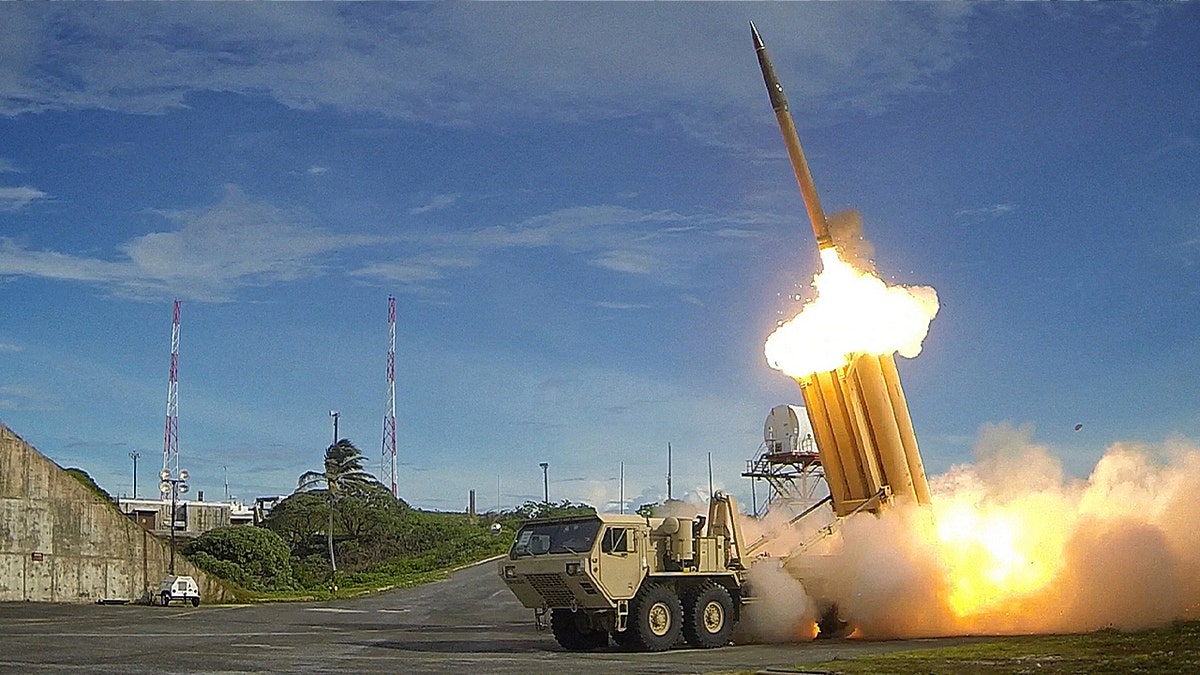
A Terminal High Altitude Area Defense (THAAD) interceptor is launched during a successful intercept test, in this undated handout photo provided by the U.S. Department of Defense, Missile Defense Agency. (U.S. Department of Defense, Missile Defense Agency/Handout via Reuters)
Despite these operational constraints, U.S.-made air defense systems continue to perform admirably in battle. The problem is depth, not capability. Iran has made it clear that we simply don't have enough of that proven hardware to sustain a long fight.
US DRAINS CRITICAL MISSILE STOCKPILES IN IRAN WAR AS YEARSLONG REBUILD LOOMS
Fortunately, recent contract announcements from the Pentagon show that a commitment to fixing this problem is taking hold. The Navy announced a $22.9 billion, seven-year contract to ramp up Tomahawk cruise missile production from roughly 60 a year to more than 1,000. This multiyear commitment provides long-range certainty that lets industry hire the workforce, expand facilities and lock in suppliers around real, sustained demand, as opposed to reacting to it year to year.
It’s a welcome shift that’s part of a larger trend. Since January, the Pentagon signed long-term framework agreements with both RTX and Lockheed Martin covering seven major weapons systems, all built on the same seven-year model. Together, these deals will push AMRAAM production to 1,900 units a year, SM-6 to more than 500, PAC-3 interceptors from 600 to 2,000, and THAAD from 96 to 400. The message behind the numbers is straightforward: The Pentagon wants stockpile depth built in permanently, not scrambled together the next time a war breaks out.
VANCE PUSHES BACK ON REPORT OF STOCKPILE CONCERNS AS US RACES TO BOOST MISSILE PRODUCTION
While this is a helpful first step, it won't single-handedly solve the problem. Even under these agreements, full production capacity will take time to arrive, and Congress must approve continued appropriations to fund them through completion. The military is also still working against an outdated procurement process that limits how fast any new capability, not just these missile systems, can reach the warfighter. The U.S. still averages more than 12 years to move a major weapons program from concept to fielding, and that's a separate challenge the Pentagon and Congress still need to resolve.
CLICK HERE FOR MORE FOX NEWS OPINION
Moving forward, the Pentagon and Congress should understand that treating sustained, elevated defense investment as the standing cost of this era, not a wartime exception that ends when the current conflict does.
CLICK HERE TO DOWNLOAD THE FOX NEWS APP
The industrial base that wins the next fight is the one we choose to build now, deliberately, before we need it.
Gen. Philip Breedlove (Ret.) is a former Supreme Allied Commander of NATO and former Commander of U.S. European Command.