NEWYou can now listen to Fox News articles!
Sex "discrimination" or gender "fairness" in scholastic activities? The Supreme Court will decide the divisive social question when it holds oral arguments Tuesday in a pair of cases reviewing separate state bans on transgender and non-binary athletes participating in female-only public school sports teams.
The justices are hearing appeals from Idaho and West Virginia, after lower courts struck down state laws, affecting those students from the elementary to college level.
The Trump Justice Department is supporting the state laws, and will have time at oral argument to talk about the federal implications.
What the court does here could affect other legal fights over LGBTQ+ rights, including transgender people having access to bathrooms, or sex designation on documents like passports and driver's licenses.
The justices could decide to rule narrowly on the rights of athletic competitors or offer a more sweeping precedent over discrimination claims in the workplace, public spaces, military service, government benefits, housing, health care and education.
The plaintiffs want to play
One of the equal protection challenges comes from Lindsay Hecox, a 24-year-old senior at Boise State University who wanted to compete on both NCAA-level and club sports teams for women.
Hecox now wants her high court case dismissed, fearing further harassment as she expects to graduate from college this spring. She says she will no longer play women's sports in Idaho, but the justices will decide that question of mootness after argument.
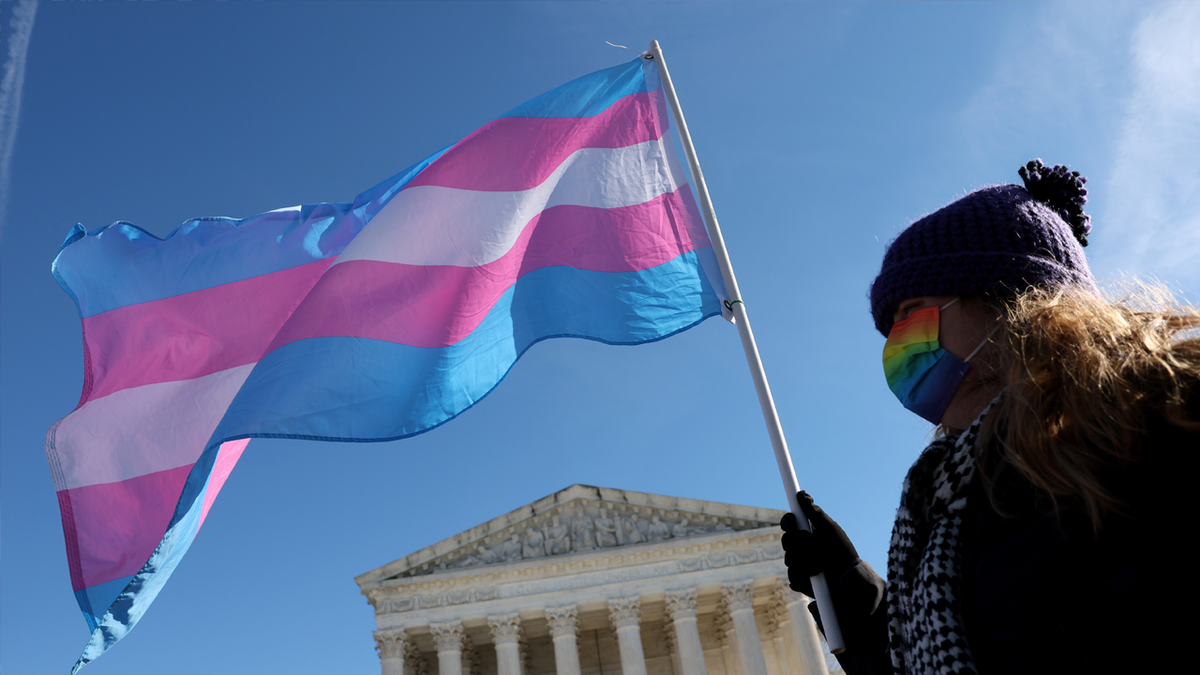
A transgender rights supporter takes part in a rally outside the U.S. Supreme Court as the high court hears arguments in a case on transgender health rights on Dec. 4, 2024 in Washington, D.C. (Photo by Kevin Dietsch/Getty Images)
In West Virginia, now 15-year-old Becky Pepper-Jackson seeks to play on women's teams at her public middle and now high schools.
This past year, Pepper-Jackson qualified for the West Virginia girls high school state track meet, finishing third in the discus throw and eighth in the shot put in the Class AAA division.
She has identified as female since third grade, and has been taking puberty-blocking medication.
Although she is officially listed in court as B.P.J., her mother and ACLU lawyers have publicly identified her by Becky's full name.
Both plaintiffs have complained of harassment and intimidation over their lawsuits.
But two fellow students from Pepper-Jackson's high school spoke to Fox News, claiming she harassed them when seeking to compete.
The states and the stakes
Idaho and West Virginia are among almost 30 states with laws preventing transgender students who identify as female from competing on girls' sports teams sponsored by public schools and colleges.
The justices will examine whether the landmark federal law, Title IX forbidding sex discrimination in education, applies in these inclusion cases.
Idaho in 2020 became the first state to pass such restrictions with the Fairness in Women's Sports Act.
West Virginia the following year enacted the Save Women’s Sports Act.
The justices in 2023 temporarily blocked that state from enforcing its ban while the case continued being litigated.
Competing arguments
Both sides in the legal dispute have accused the other of peddling false and misleading facts, terminology and narratives about enforcement of the state laws, and the stakes for both transgender and cisgender athletes.
The Supreme Court in July agreed to hear the separate appeals from the states and is expected to issue final, binding rulings on the merits by late June.
"Idaho’s women and girls deserve an equal playing field," said Idaho Attorney General Raul Labrador, who is expected to argue the case in Tuesday's public session. "For too long, activists have worked to sideline women and girls in their own sports."
States with such laws, and groups and lawmakers supporting them, say the issue is about common sense and student safety.
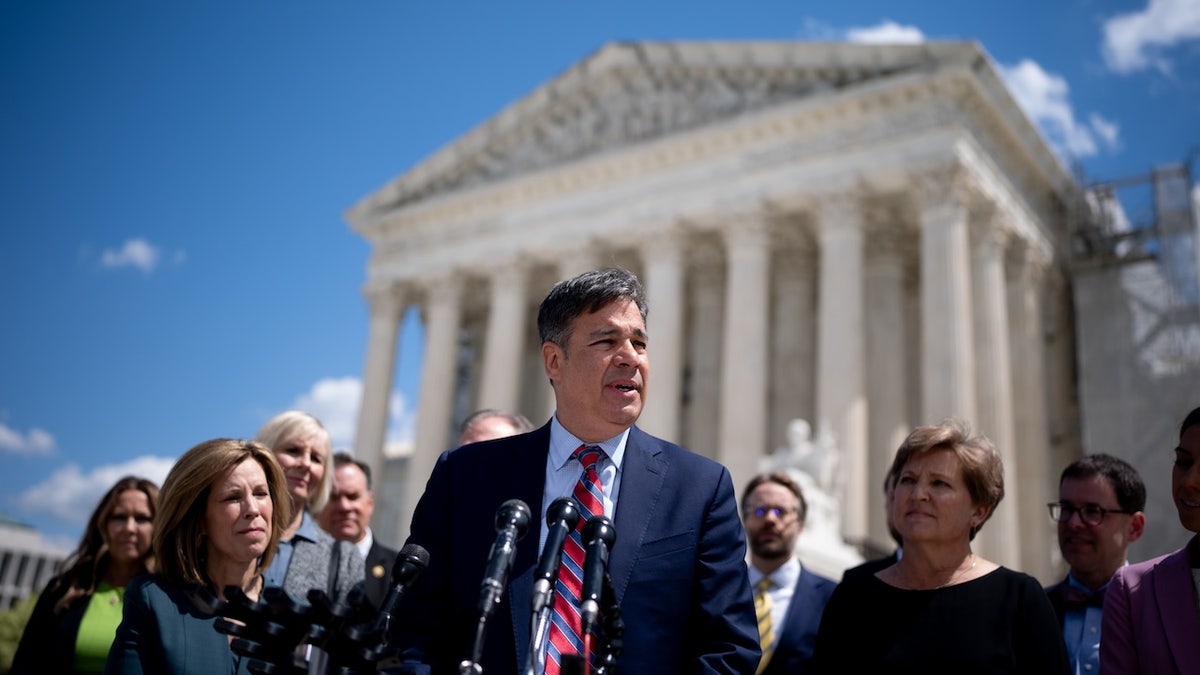
Idaho Attorney General Raul Labrador speaks outside the Supreme Court on April 24, 2024, in Washington, D.C. (Andrew Harnik/Getty Images)
Lawyers will tell the high court there are inherent physical differences between females and males, and these legislative acts would ensure those they call "male" or "boy" students cannot compete on girls’ sports teams involving competitive skill or contact.
But LGBTQ+ rights supporters say such laws and labels are clearly discriminatory, and were never a big issue until some states sought to politicize them.
The ACLU, which is helping represent Pepper-Jackson and Hecox, told the court that many states, athletic organizations, and governing bodies have successfully balanced what they describe as inclusion and access to play without any problem.
"I play for my school for the same reason other kids on my track team do – to make friends, have fun, and challenge myself through practice and teamwork," said Pepper-Jackson in a statement provided by the ACLU. "And all I’ve ever wanted was the same opportunities as my peers. Instead, I’ve had my rights and my life debated by politicians who’ve never even met me but want to stop me from playing sports with my friends."
The numbers
There is no clear number of transgender or non-binary student athletes in K-12, collegiate or professional sports in the U.S., but the numbers appear relatively small.
NCAA President Charlie Baker told Congress in 2024 that fewer than 10 of over 500,000 NCAA athletes are transgender.
SCOTUS DEFENSE IN CASES TO PROTECT WOMEN'S SPORTS GETS SUPPORT FROM 27 STATE ATTORNEYS GENERAL
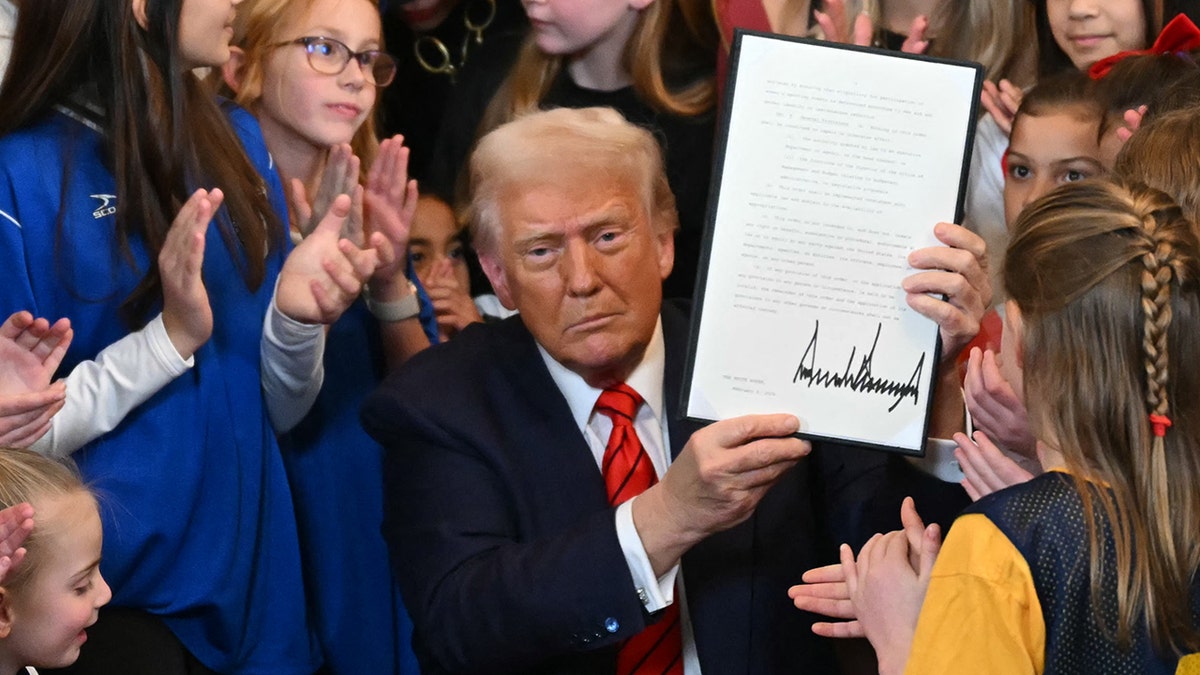
President Donald Trump signs the No Men in Women's Sports Executive Order into law in the East Room of the White House in Washington, D.C., on Feb. 5, 2025. (Andrew Caballero-Reynolds/AFP via Getty Images)
The issue of transgender participation in scholastic sports has divided the country and the courts.
The University of Pennsylvania last summer agreed to adhere to the resolution agreement reached with the U.S. Department of Education Office for Civil Rights after an investigation found that UPenn violated Title IX during the 2021-22 season because of the inclusion of transgender swimmer Lia Thomas.
As part of the resolution, UPenn agreed to restore titles previously held by Thomas and issue an apology to female athletes impacted by the university’s policy, which the Education Department found had violated Title IX.
What the court might do
The Supreme Court has offered a mixed record this decade on the rights of transgender people.
A 6-3 majority in 2020 concluded federal employment discrimination laws protect gay and transgender employees.
Writing the majority opinion, Justice Neil Gorsuch said the federal law known as Title VII applied to a transgender employee fired by a funeral home owner.
"The answer is clear. An employer who fires an individual for being homosexual or transgender fires that person for traits or actions it would not have questioned in members of a different sex," said Gorsuch. "Sex plays a necessary and undisguisable role in the decision, exactly what Title VII forbids."
But last year, the court's conservative 6-3 majority upheld a Tennessee law restricting certain forms of medical treatment for transgender minors — saying the ban was grounded on the basis of age and medical care, not sex or transgender status.
"This case carries with it the weight of fierce scientific and policy debates about the safety, efficacy, and propriety of medical treatments in an evolving field," wrote Chief Justice John Roberts in the majority opinion. "Our role is not 'to judge the wisdom, fairness, or logic' of the law before us, but only to ensure that it does not violate the equal protection guarantee of the Fourteenth Amendment. Having concluded it does not, we leave questions regarding its policy to the people, their elected representatives, and the democratic process."
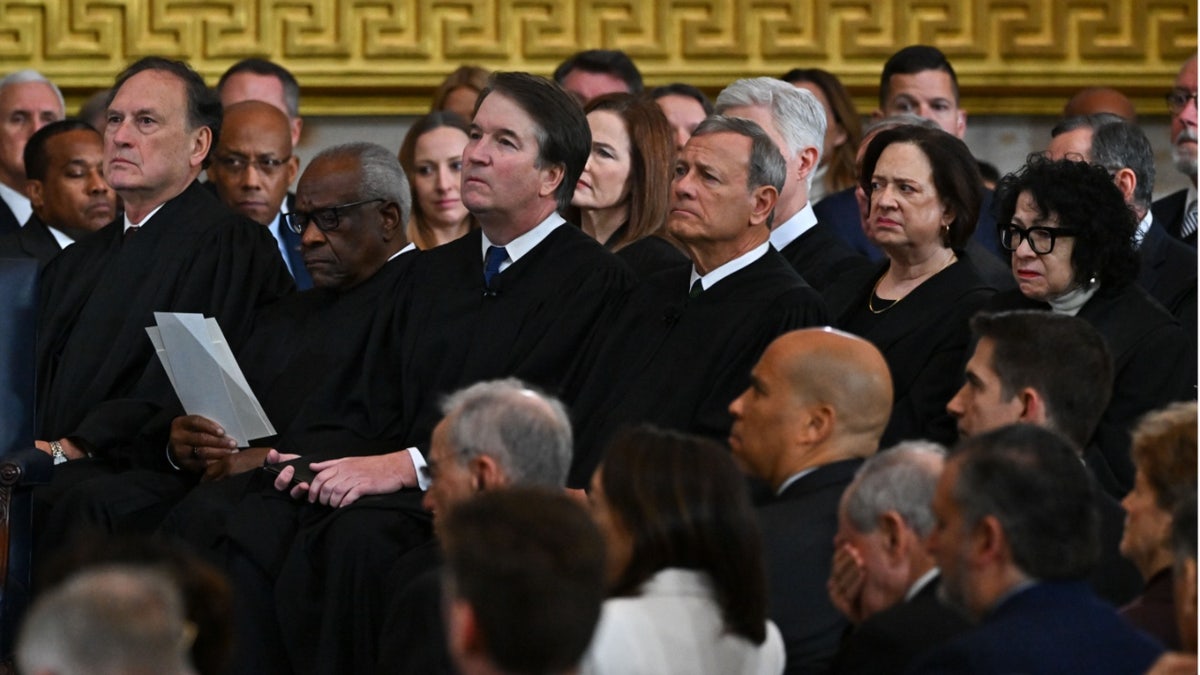
Supreme Court Justice Samuel Alito, Supreme Court Justice Clarence Thomas, Supreme Court Justice Brett M. Kavanaugh, Supreme Court Justice Amy Coney Barrett, Supreme Court Chief Justice John Roberts, Supreme Court Justice Elena Kagan and Supreme Court Justice Sonia Sotomayor attend the 60th inaugural ceremony on Jan. 20, 2025, at the U.S. Capitol in Washington, D.C. (Ricky Carioti/The Washington Post via Getty Images)
The question now could come down to whether the court views individual transgender claims as very different in the employment context from the sports participation context, especially those involving underage public school athletes.
That legal articulation may now guide the high court in the current disputes, with some legal experts predicting the justices will take a cautious, limited approach to resolving this specific issue.
"The gender identity cases are a largely undeveloped area of law, certainly a lot less developed than other areas of constitutional law," leading appellate attorney Thomas Dupree told Fox News. "The court has shown a willingness to say: look, these are hotly debated issues to the extent they involve questions of health or medicine or science. They're being debated by people of good faith on either side. And who are we as judges to insert ourselves in that process and proclaim what we think is right."
Some on the court may be persuaded that these types of issues, at least for the time being, may best be resolved through the democratic process, rather than by hard rules issued by the Supreme Court.
CLICK HERE TO DOWNLOAD THE FOX NEWS APP
Allowing state legislators and Congress some greater flexibility to enact laws — with minimal input from the courts — might give judges more time to see the practical and legal effects play out — and over time, things could reach a plateau for greater judicial intervention.
The high court cases are Little v. Hecox (24-38) from Idaho; and West Virginia v. B.P.J. (24-83).
Shannon Bream currently serves as anchor of FOX News Sunday. She joined the network in 2007 as a Washington D.C- based correspondent covering the Supreme Court.