NEWYou can now listen to Fox News articles!
With the nomination of Graham Platner in Maine on June 9, the Democratic Party’s record of advancing extreme, left-wing progressive candidates for Congress has begun to take full form.
Indeed, Democrats are set to enter the midterm general election cycle potentially with a slate of nominees whose positions and backgrounds may do more to help rescue the GOP than anything Republicans have done or will be able to do for themselves.
Despite an arguably favorable political environment for the Democrats – who lead the generic congressional vote by five points – a divided Republican majority in both chambers, and an extremely angry electorate who now give President Donald Trump a job approval rating of 40% – about four points below what it was at this point in the 2018 cycle – the Democratic Party has yet again taken steps to shoot itself in the foot before what may have been emerging as a 2018-style landslide.
Platner, who has been deeply embroiled in scandal after scandal, just became the new Democratic standard-bearer in Maine, securing slightly more than 70% of the vote – and in turn, risking Democrats’ chances of flipping a crucial seat needed to win control of the Senate come November.
TOP TAKEAWAYS FROM THE PRIMARY ELECTIONS IN MAINE AND SOUTH CAROLINA: 'MOVEMENT ABOUT US'
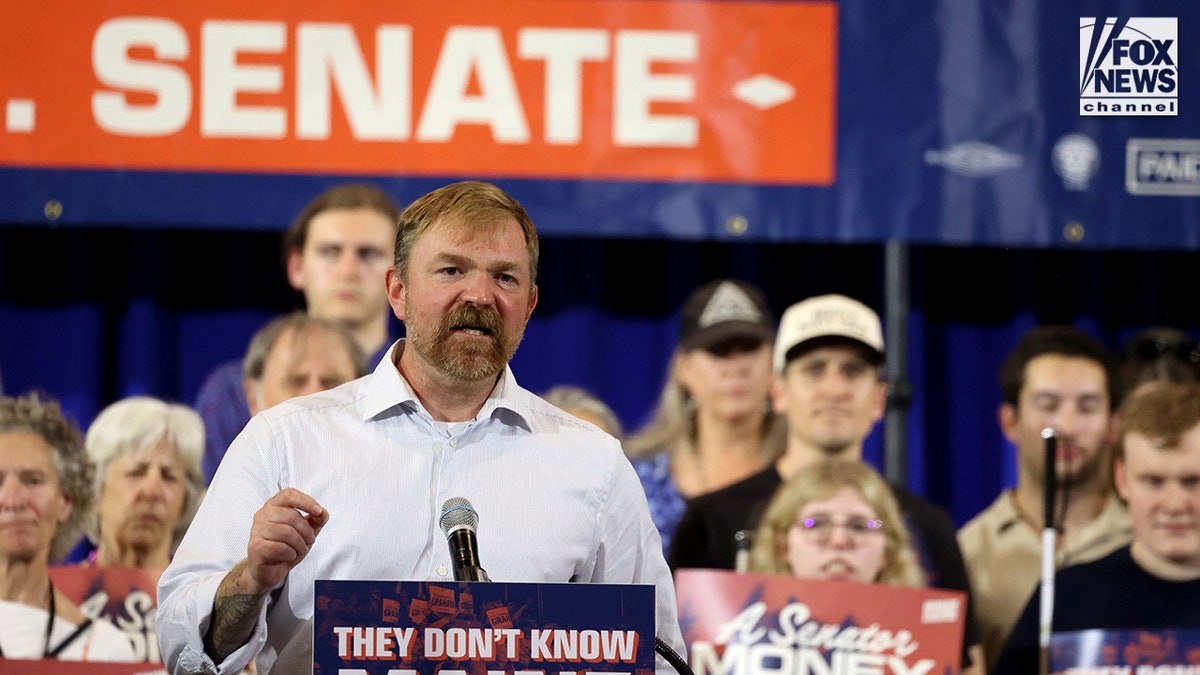
Graham Platner addresses the crowd at his watch party at a YMCA in Blue Hill, Maine, June 9, 2026, after winning the Democratic nomination for U.S. Senate. (Matthew Symons for Fox News Digital)
Indeed, Platner is both so extreme and so compromised that his support from Democratic leadership, along with other extremist candidates, could well become a deciding issue in the midterms.
Between allegations of abusive behavior in past relationships, reports that he engaged in inappropriate communication with women while married and fallout from a tattoo that at least one of his girlfriends said he acknowledged proudly was a Nazi symbol, Platner seems to possess every liability imaginable for a Democratic candidate in today’s climate. And he has support from the Democratic Socialists of America – the same organization that supports massive tax increases and transgender rights, attacks capitalism and calls for the complete abolition of ICE.
Yet, by primary night earlier this week, Platner had not only appeared to weather the controversies but had also secured the nomination – all while Democratic leaders in Maine and nationally offered little to no resistance, for reasons clearly related to taking back control of the upper chamber.
GRAHAM PLATNER FINALLY EMBRACED BY POWERFUL MAINSTREAM DEM LEADERS AFTER PRIMARY ELECTION VICTORY
Critically, the consequences of Platner’s win for the Democratic Party are likely to impact his Senate campaign and the campaign for governor of Maine, and will indeed reverberate throughout the whole country.
A Tavern Research poll completed two days before the primary showed a generic Democrat ahead of Republican incumbent Susan Collins by 10 points (55% to 45%), yet Platner’s actual lead over Collins was much lower (+2, 51% to 49%).
Further, as my firm, Schoen Cooperman Research, was involved in the Democratic gubernatorial primary, we have seen the impact Platner has had on the once-leading progressive Troy Dale Jackson, who currently sits in third with 21% of the vote, trailing Nirav Shah (27%) and Hannah Pingree (23%).
SCANDAL-PLAGUED PLATNER CAPTURES DEMOCRATIC SENATE NOMINATION
In other words, it’s clear that, while Platner’s scandals failed to derail his primary bid, they are more than capable of damaging Democratic electability up and down the ballot, as well as nationally in the fall, at precisely the moment the party should be expanding its appeal.
And, luckily for the Republicans, the Democrats’ candidate-quality problem extends well beyond Maine.
Indeed, Platner is both so extreme and so compromised that his support from Democratic leadership, along with other extremist candidates, could well become a deciding issue in the midterms.
In Michigan, far-left Senate candidate Abdul El-Sayed – who is supported by extreme radical and antisemite podcaster Hasan Piker – has emerged as the frontrunner in the race for the Democratic nomination against two incumbent members of the House, even as his uber-progressive record – including his support for abolishing ICE and halting all aid to Israel – threatens to become a liability come the general election.
DAVID MARCUS: THE AGE OF THE DEMOCRATIC PARTY BLOCKING FRINGE OUTSIDERS IS OFFICIALLY OVER
As for the House, in New Jersey’s 12th district, Adam Hamawy – a far-left extremist who testified in support of terrorist Omar Abdel-Rahman in the 1990s – adds to Democrats’ growing roster of candidates who will only push the party farther away from the center.
PROGRESSIVE FRONTRUNNER IN CRUCIAL SENATE RACE FACES BACKLASH OVER COMMENTS PRAISING HAMAS RAID
Likewise, in Pennsylvania’s 3rd district, Democratic nominee Chris Rabb also exemplifies the party’s leftward shift, gaining endorsements from both Piker and the DSA.
To be clear, though, the Democratic Party’s problems, while pronounced, cannot be solely attributed to its slate of far-left candidates.

Sen. Bernie Sanders, I-Vt., stands with Senate candidate Abdul El-Sayed (Left) after speaking at Mumford High School on May 3, 2026, in Detroit, Mich. (Sarah Rice/Getty Images)
Rather, the party’s structural dysfunction runs much deeper: Democrats remain polarized and divided, with ideological and personal fissures that have the taken the form of an intra-party struggle between progressive members of Congress, like Vermont Independent Sen. Bernie Sanders and New York Rep. Alexandria Ocasio-Cortez, and establishment Democratic leadership, like Senate Minority Leader Chuck Schumer and House Minority Leader Hakeem Jeffries.
DOUG SCHOEN: DEMOCRATIC BATTLE PITS MODERATES VS. PROGRESSIVES FOR SOUL OF THE PARTY
For one, a number of current senators – Elizabeth Warren, of Massachusetts, Tina Smith, of Minnesota, and Chris Murphy, of Connecticut , dubbed the "Fight Club" – have already signaled they will oppose Schumer’s reelection as either the Senate majority or minority leader, and several other congressional hopefuls have begun to follow suit.
Additionally, the return of the Bidens isn’t doing much to help Democrats’ case either.
Between the releases of former First Lady Jill Biden’s memoir– which highlights former President Joe Biden’s obvious disabilities, including the initial belief that he had a stroke during the June 2024 debate – and of the Democrats’ internal post-election audit – which revealed a party with no clear message or strategy – the left has managed to make 2024 a 2026 problem.
The advantage for Republicans is clear: they now have the choice to make the midterms a referendum on Biden vs. Trump, on middle-left vs. far-left, or on the Democrats’ extreme candidates, since none have yet to be disavowed.
And while it’s certainly the case that Democrats are still favored to win the House – with Senate control remaining very much in play – the GOP, given the negatives, has lines of attack that it arguably did not have back in 2018.
There are simple solutions, however unlikely the party may be to pursue them.
CLICK HERE FOR MORE FOX NEWS OPINION
In Maine, if there are more revelations about Platner, he can and should step down by July 13 to allow someone like Gov. Janet Mills, who made clear her availability, to run in his place. Notably, Mills has a three-point lead over Collins in the above Tavern Research poll.
And, luckily for the Republicans, the Democrats’ candidate-quality problem extends well beyond Maine.
In Michigan, the Democrats have two otherwise qualified House candidates who are far stronger general election candidates than El-Sayed.
CLICK HERE TO DOWNLOAD THE FOX NEWS APP
And nationwide, the party should develop a substantive, forward-looking agenda that offers a real alternative to Trump’s policies – like affordability, immigration reform and border security, and economic growth – that goes beyond investigations and impeachment proceedings.
In sum, there is still time for Democrats to get out of their own way – but if Tuesday night’s election is any indication, the will to do so remains an open question.
CLICK HERE TO READ MORE FROM DOUG SCHOEN
Douglas E. Schoen has more than 40 years of experience as a pollster and political consultant. He served as an adviser to President Bill Clinton and to the presidential campaign of Michael Bloomberg. Schoen is founder and partner of Schoen Cooperman Research.